
ENVIRONMENTS AND PLASTIC INTEGRATION TO ARCHITECTURE


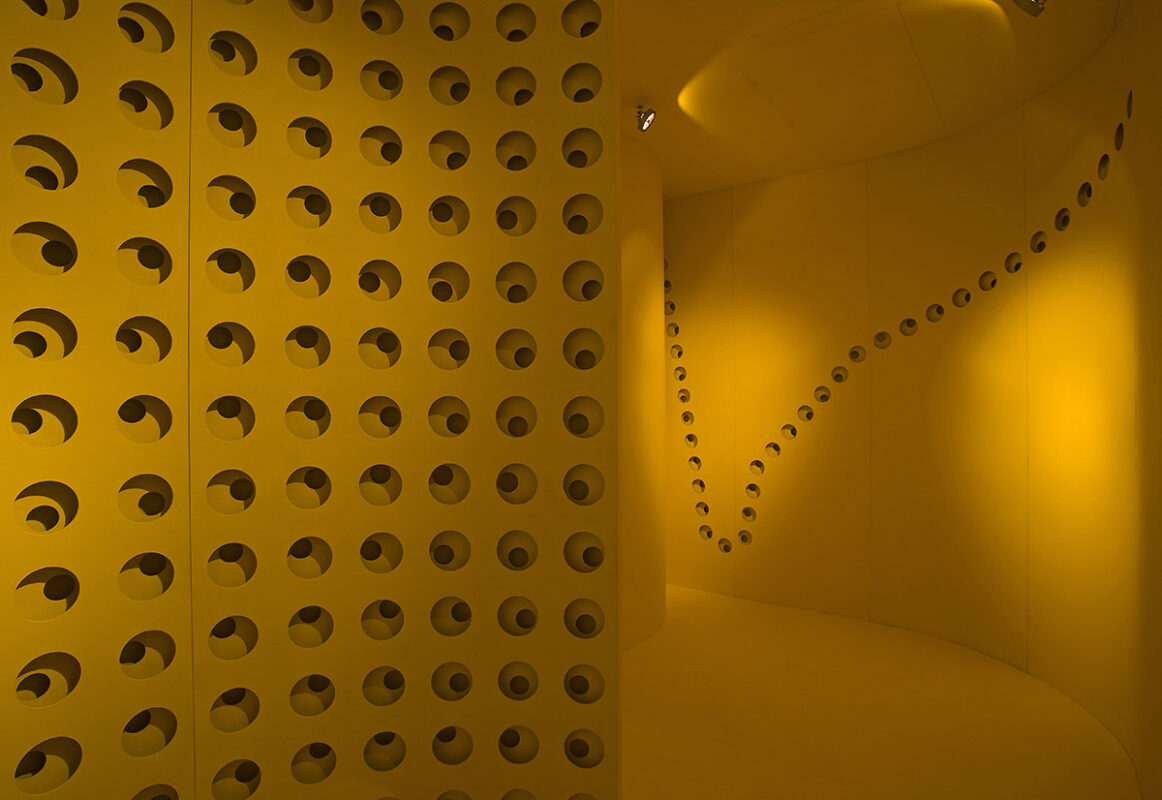

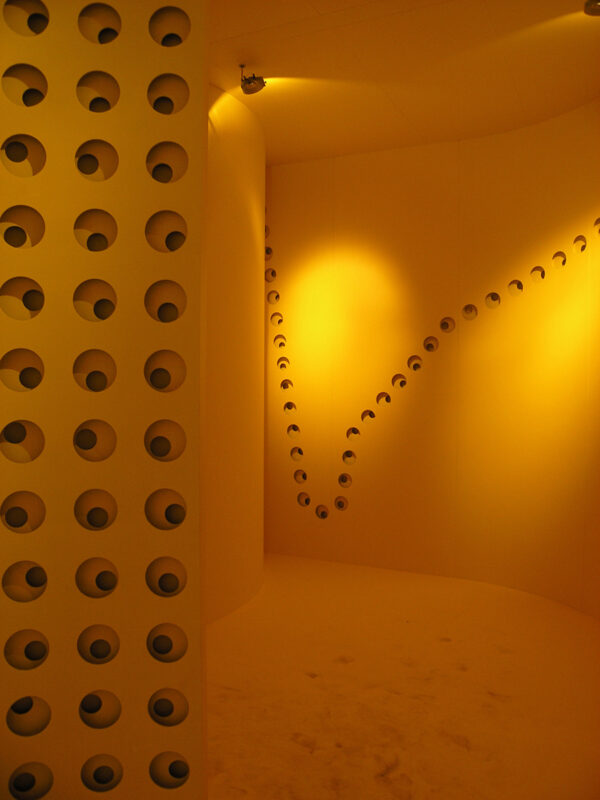
Paolo Scheggi, "Intercamera plastica" (Plastic Interchamber), 1966-1967, wooden structure and curved, die-cut wooden sheets painted yellow, 540 x 435 x 320 cm. The Plastic Interchamber was originally yellow painted; it has been white painted by Scheggi for the group show Lo spazio dell’immagine (The Space of the Image) held at Palazzo Trinci in Foligno (2 July-1 October 1967). Since the original Interchamber has been partially lost, the Paolo Scheggi Archive realized an authorized version of it in 2007. This version has been donated by Franca and Cosima Scheggi to the Center for Contemporary Art “Luigi Pecci” in Prato in 2013.
"The theme of the wound and the cut runs through the history of art up to Lucio Fontana. It is the account of an ideal journey into the unknown, first spiritual and then physical. The desire to venture into a void to be known and experienced: a thing in itself that is linked to the value of emptiness and silence. A path of openness of the mind as much as of the gaze that has opened the horizon of images to a space and time that cannot be confined, even if identifiable. The starting point is Fontana's "Spatial Concepts" which, not wanting to close off the research in precise enclosures, broadens the horizon by opening up new territories beyond the canvases. The result is a declaration of totality where the fullness and void, presence and absence form a whole with interdependent polarities. A transit that Paolo Scheggi (1940-1971) systematises, ...structuring and sequencing the crossings of the canvas in order to construct a controlled and rational plastic whole. His formalisation of the relationship between positive and negative, luminous and obscure, is, however, absolute, in the sense of being freed from any relationship with other realities that are not "purovisibilist". One can therefore understand the aspiration to create a totally autonomous environment, now reconstructed, "Intercamera plastica", 1966-67 (...) which tends to find a continuity between pictorial object and architecture. An intensity of components is formed, interconnected by the return to the circular form, which become variable levels of optical knowledge. And they stimulate an aesthetic experience of void and full: a discipline and an exercise based on the balance and harmony of things, abstract and concrete".
Germano Celant, 2013